Description
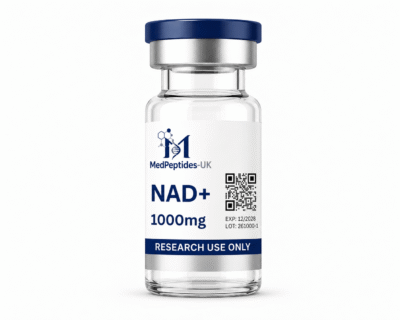
NAD+ 1000mg | Nicotinamide Adenine Dinucleotide
IMPORTANT: RESEARCH USE ONLY
NAD+ is supplied as a lyophilized powder intended exclusively for scientific and laboratory research purposes (Research Use Only, RUO).
This material is not intended for human or veterinary use, human consumption, diagnostic procedures, or therapeutic applications.
Also Known As: NAD+, Nicotinamide Adenine Dinucleotide, Oxidized Nicotinamide Adenine Dinucleotide
PRODUCT OVERVIEW
NAD+ (Nicotinamide Adenine Dinucleotide) is an essential cellular coenzyme found across living systems and involved in numerous biochemical processes.
It exists in oxidized (NAD+) and reduced (NADH) forms, allowing it to participate in cellular redox reactions and electron transfer. These functions make NAD+ an important compound in research involving cellular metabolism, energy production, mitochondrial function, and biochemical signalling.
NAD+ is also studied as a substrate for several classes of NAD+-consuming enzymes, creating additional research interest in areas involving cellular signalling, metabolic regulation, DNA-associated processes, and cellular stress responses.
Experimental studies may investigate NAD+ concentrations, NAD+/NADH balance, enzyme activity, metabolic pathways, mitochondrial processes, and other mechanisms associated with cellular energy metabolism.
Each vial contains 1000mg of NAD+ in lyophilized form.
RESEARCH BACKGROUND
NAD+ is a naturally occurring coenzyme with a central role in cellular biochemistry.
One of its best-established functions is its participation in oxidation-reduction reactions. NAD+ can accept electrons during biochemical reactions to form NADH, while NADH can subsequently participate in other metabolic reactions.
This NAD+/NADH redox relationship is fundamental to numerous metabolic pathways and has made NAD+ an important research compound in studies of cellular respiration, mitochondrial metabolism, energy transfer, and metabolic regulation.
NAD+ is also involved in enzyme-dependent cellular processes beyond its traditional redox role, contributing to continued research into its wider involvement in cellular signalling and metabolic homeostasis.
MECHANISM OF RESEARCH INTEREST
NAD+ primarily functions as a redox cofactor, participating in biochemical reactions involving the transfer of electrons.
The interconversion between NAD+ and NADH supports numerous metabolic reactions involved in cellular energy production and substrate metabolism.
NAD+ also serves as a substrate for several enzyme families involved in cellular regulation. Research into these pathways has expanded scientific interest in NAD+ beyond its classical role in energy metabolism.
Its involvement in both redox chemistry and enzyme-dependent signalling makes NAD+ useful for experimental investigation across biochemistry, molecular biology, mitochondrial research, and cellular metabolism.
RESEARCH APPLICATIONS
- NAD+ and NADH metabolism research
- Cellular energy metabolism studies
- Oxidation-reduction reaction research
- Mitochondrial function investigations
- Cellular respiration research
- Metabolic pathway studies
- NAD+-dependent enzyme research
- Cellular signalling investigations
- Energy homeostasis research
- Oxidative metabolism studies
- Cellular stress-response research
- Biochemical and enzymatic assays
- Metabolic regulation research
PRODUCT SPECIFICATIONS
Product Name: NAD+
Full Name: Nicotinamide Adenine Dinucleotide
Active Ingredient: NAD+
CAS Number: 53-84-9
PubChem CID: 10897651
Molecular Formula: C21H27N7O14P2
Molecular Weight: Approximately 663.4 g/mol
Appearance: White to off-white lyophilized powder
Physical Form: Lyophilized Powder
Quantity: 1000mg per vial
Product Classification: Research Use Only (RUO)
Packaging: Sealed research vial
STORAGE & HANDLING
- Long-Term Storage: Store at -20°C in the original sealed container for optimal long-term stability.
- Short-Term Storage: Store refrigerated at 2-8°C for up to a few months.
- Protect from direct light, excessive heat, and moisture.
- Keep the vial tightly sealed during storage.
- Minimize unnecessary temperature fluctuations.
- Avoid repeated freeze-thaw cycles.
- After Reconstitution: Store refrigerated at 2-8°C and avoid repeated temperature cycling.
- Recommended Use After Reconstitution: Use within 28 days when stored refrigerated at 2-8°C.
- Shelf Life: Up to 24 months from the date of manufacture when stored under the recommended long-term storage conditions.
Storage and stability periods should be confirmed against the applicable product documentation or Certificate of Analysis (COA).
RESEARCH SAFETY INFORMATION
NAD+ supplied in this format is intended for controlled scientific and laboratory research.
The material should be handled by appropriately trained personnel using suitable laboratory procedures and personal protective equipment.
Information provided regarding NAD+ is intended to summarize established biochemical functions and areas of scientific research.
Scientific Information Notice: The information provided above is for research reference only. It does not constitute medical advice, dosing guidance, treatment recommendations, or instructions for human use.
REGULATORY & RESEARCH USE NOTICE
FOR RESEARCH USE ONLY. NOT FOR HUMAN OR VETERINARY USE.
This product is intended solely for scientific and laboratory research.
This product is not supplied as an approved medicinal product. It is not intended for human consumption, diagnosis, treatment, prevention of disease, or any clinical or therapeutic application.
Purchasers are responsible for ensuring that the purchase, possession, storage, handling, and use of this material comply with all applicable laws, regulations, institutional requirements, and laboratory safety procedures.
Product-specific information, including batch testing and purity where applicable, should be referenced against the relevant Certificate of Analysis (COA).
Images for illustration purposes only.